|
Cataracts : Over 40,000 North Americans Are Affected
|

 |
 |
 |
|
|
 |
 |
 |
Shakespeare (on life with cataracts) Thy sight is young, And thou shalt read when mine begin to dazzle.
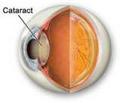
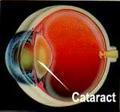
This is a clouding of the lens of the eye.
This process occurs to everyone as we age, to a lesser or greater extent.
It is a natural part of the aging process, but its progression can be slowed.
The lens has a crystalline structure made of protein fibers.
These fibers are finely dispersed throughout the lens, giving it the transparency it needs to function.
Perfect operation of the lens requires normal concentrations of sodium, potassium and calcium.
These levels are maintained by the sodium-potassium pump, which is a sulphur-containing protein.
As you age, the sodium-potassium pump works less effectively: more sodium remains in the lens and less potassium gets into it.
This imbalance makes the fibers that form the lens begin to clump together (much the same process that turns an egg white from clear to white during cooking).
Older fibers are also pushed to the center of the lens.
The clumping and pushing cause the lens to cloud over.
The sodium-potassium pump is damaged by Free Radicals and by UV radiation.
Free radicals can come from many sources, including natural body processes as you age, and cigarette smoking.
The lens protects the delicate Retina from UV radiation; unfortunately, in the process, the lens itself becomes damaged.
This process becomes a vicious circle: the originally clear lens becomes slightly opaque due to absorption of UV radiation.
This opacity causes the lens to absorb even more UV, which makes the lens even more opaque, which causes more absorption.
Eventually, they develop and vision is drastically impaired.
This process is gradual, and many people don’t notice any Loss of Vision until it begins to affect their lives.
 |
 |
|
|
|
 |
 |
 |
Symptoms
Symptoms include hazy vision, halos, glare, difficulty focusing, rapid eye fatigue, and possibly Double Vision.
If you wear Prescription Glasses, and your vision without them improves as you grow older, it may be an indication of this.
This can change the prescription of your eye.
Try this Vision Simulator to see what vision deterioration from your eyes looks like.
Risk Factors
Risk factors for this include the following:
- UV radiation from sunlight
- dehydration
- smoking and secondhand smoke
- heavy alcohol consumption
- lack of exercise
- diabetes, heart disease, hypertension, and arthritis, and the drugs used to treat them
- obesity
- over 300 prescribed medications that, when combined with exposure to sunlight, actually speed up cataract formation
- lack of estrogen, which seems to have a protective effect against this (women over 50 are twice as likely as men to develop them)
- lack of sleep.
Treatment and Cure
There is no cure for them.
Before the lens is completely clouded over, increasingly stronger corrective eyeglasses will help.
And once the lens is too clouded over for even eyeglasses to help, surgery can restore sight to a person with this.
Surgery involves making an incision in the cornea and removing the damaged lens.
A plastic lens is then inserted into the eye.
Healing time is one month or less, depending on the method of surgery.
The plastic lens cannot change shape like the biological lens can, so corrective eyeglasses must be prescribed about ten weeks after surgery.
Products to Help You Prevent This
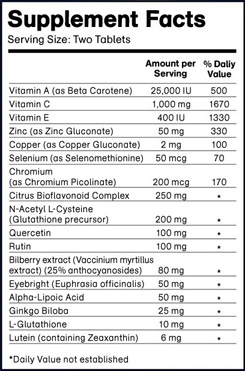
Since almost all the damage to the lens is caused by UV radiation and free radicals, protecting the eyes from UV and providing them with enough Eye Health Antioxidants will help slow the progression of the Eye Disease.
Wear a pair of Sunglasses that block 100% of UV radiation, and ensure that you are ingesting enough antioxidants to keep your eyes healthy.
Remember nothing beats a healthy diet with the right balance of Vitamins and Minerals when it comes to preventing an Eyesight Problem.
Here is some more Cataract Information
Cataract Books
Books on Eye Health
|
|

Subscribe to EyeSight Vision Care! , our monthly newsletter with in depth information to help you keep up to date on how to Protect Your Eyesight with a free bonus. Fill out the form below. You'll then receive an email asking you to confirm that you subscribed. You'll always have the option to unsubscribe at the click of your mouse.

More Information